Abdomen Pain Chart: What Does the Location of Your Pain Mean?

Your body has a way of pointing directly at what’s wrong if you know how to read the map. Abdominal pain location is one of the most reliable clues your body gives you, and understanding it can help you recognize when symptoms are serious enough to warrant emergency care.
Here’s what your abdominal pain location can tell you:
- Upper right pain: Often linked to the gallbladder or liver
- Upper left pain: May point to the stomach, spleen, or pancreas
- Lower right pain: Commonly associated with appendicitis
- Lower left pain: Frequently tied to diverticulitis or the colon
- Central or upper middle pain: Can signal digestive issues like ulcers or gastritis
Not all abdominal pain fits neatly into one box, since organs sit close together and pain can radiate beyond its source. That’s where the abdomen pain chart shown below becomes useful: it breaks the abdomen into clear regions so you can match your symptoms to the areas most likely involved. Then read on for what each region means and when to seek emergency treatment for abdominal pain.
For life-threatening situations, please call 911.
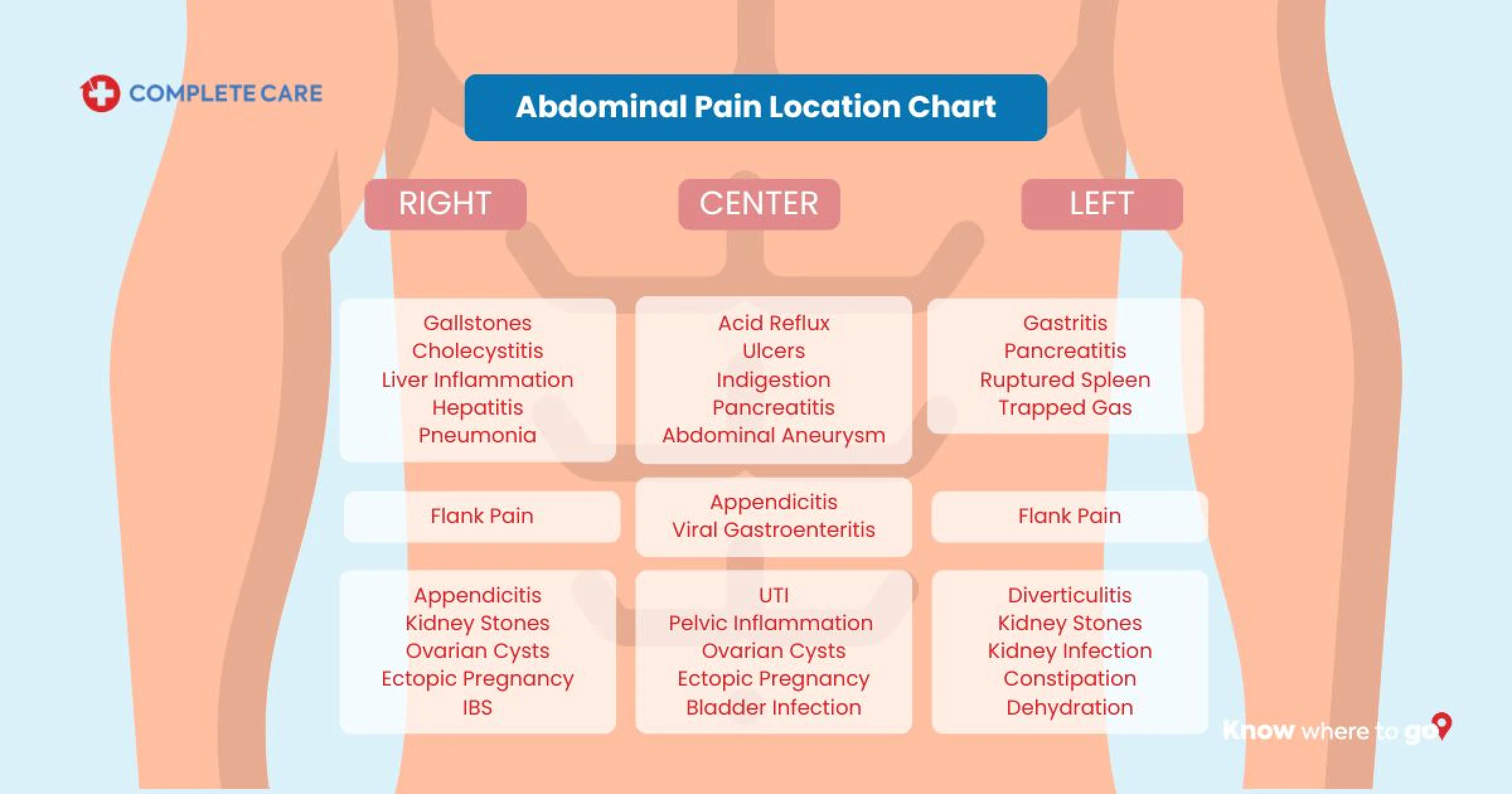
The 4 quadrants of abdominal pain and their meanings
Doctors divide your abdomen into four quadrants because each one holds a distinct set of organs, and pinpointing which quadrant hurts is often the fastest way to narrow down what’s going on. Below is a breakdown of each quadrant, the organs it contains, and what pain there commonly means.
Right upper quadrant pain (RUQ)
Pain in your right upper quadrant usually points to your gallbladder or liver, especially if it shows up after a fatty meal or comes with nausea. This area can also be a source of severe GI pain that radiates from your upper digestive tract, so it’s worth paying attention to how the pain behaves over time, not just where it sits.
What organs are in the RUQ?
- Liver: Your body’s filtering organ sits mostly on the right side
- Gallbladder: Stores bile and is a frequent source of RUQ pain
- Part of the pancreas: Wraps behind the stomach and into this region
- Right kidney: Sits toward the back of this quadrant
- Portion of the large intestine: The upper right bend of the colon
What pain may mean:
- Gallstones: Sharp pain that often follows eating, especially fatty foods
- Cholecystitis: Gallbladder inflammation, typically more constant and severe
- Hepatitis or liver inflammation: Dull ache, sometimes with jaundice
- Pneumonia: Less common, but can refer pain up into this quadrant
Left upper quadrant pain (LUQ)
Pain in the upper left quadrant is most often tied to your stomach, spleen, or pancreas, and it can range from a mild ache after eating to a sharp, sudden pain that needs urgent attention. Because several organs overlap in this area, the type of pain, not just its location, gives your provider important clues.
What organs are in the LUQ?
- Stomach: Most of it sits in this quadrant
- Spleen: Tucked toward the back left side, under your ribs
- Part of the pancreas: The tail end curves into this region
- Left kidney: Positioned toward the back
- Splenic flexure: The bend where your colon turns downward
What pain may mean:
- Gastritis or ulcers: Burning pain, often worse on an empty stomach
- Pancreatitis: Pain that radiates to the back, often after alcohol or fatty meals
- Enlarged or ruptured spleen: Sudden, severe pain, sometimes after an injury
- Trapped gas at the splenic flexure: Crampy, comes and goes with movement
Right lower quadrant pain (RLQ)
Pain in your right lower quadrant is the classic warning sign for appendicitis, particularly when it starts near your belly button and migrates down and to the right. This quadrant also overlaps with your reproductive organs, urinary tract, and lower intestine, so it’s worth ruling out more than one possibility.
What organs are in the RLQ?
- Appendix: The most well-known organ in this quadrant
- Part of the large intestine: The cecum, where your small and large intestines meet
- Right ureter: Carries urine from the kidney to the bladder
- Reproductive organs: In women, this includes the right ovary
What pain may mean:
- Appendicitis: Pain that worsens quickly, often with fever and nausea
- Kidney stones:* Sharp, cramping pain that can radiate from the back to the front
- Ovarian cysts or ectopic pregnancy: Sudden pain in women, sometimes with bleeding
- Irritable bowel syndrome: Location of IBS symptoms can also shift into the lower right quadrant, with cramping that tends to ease after a bowel movement
*Continue reading: When to go to the ER for kidney stones
Left lower quadrant pain (LLQ)
Pain in your left lower quadrant is most commonly linked to diverticulitis, a condition where small pouches in the colon become inflamed or infected. Left side abdominal pain in this region can also stem from your urinary tract or reproductive organs, so accompanying symptoms matter as much as the pain itself.
What organs are in the LLQ?
- Sigmoid colon: The lower curve of the large intestine, prone to diverticulitis
- Left ureter: Carries urine from the left kidney
- Small intestine: Loops through this region
- Reproductive organs: In women, this includes the left ovary
What pain may mean:
- Diverticulitis: Cramping, tender pain, often with fever or a change in bowel habits. Diverticulitis symptoms tend to build over a day or two rather than appearing suddenly.
- Kidney stones: Intense, wave-like pain that can move from the back to the groin
- Kidney infection: Emergency kidney infection treatment is often needed if pain comes with fever, chills, or vomiting
- Constipation: Dull, crampy pain that builds gradually
- Dehydration:Dehydration symptoms like dark urine, dry mouth, and fatigue can make this pain worse and slower to resolve
Bonus: central or upper-middle abdominal pain
Pain in the center of your abdomen, just below your breastbone, often points to your stomach or the connection between your esophagus and stomach, and it’s commonly linked to digestion rather than a single organ. Abdominal pain in the left middle of the body can sometimes blur into this central region, since the stomach spans across the midline.
What organs are in your central abdomen?
- Stomach: The upper portion sits centrally, just below the ribs
- Small intestine: Loops through the middle of your abdomen
- Pancreas: Sits deep and central, behind the stomach
- Aorta: The body’s main artery passes through this region
What pain may mean:
- Acid reflux or ulcers: Burning pain, often worse when lying down
- Indigestion: Fullness or discomfort after eating, usually mild
- Pancreatitis: Pain that radiates straight through to the back
- Rarely, an abdominal aortic aneurysm: Sudden, severe, tearing pain that requires emergency care
Other central locations worth knowing:
- Center or navel (periumbilical): This area sits near the small intestine, and pain here is a common early sign of appendicitis before it moves to the lower right, or a symptom of viral gastroenteritis
- Flanks (sides): Pain along the sides of your torso usually traces back to the kidneys, showing up with kidney stones, urinary tract infections, or a kidney infection (pyelonephritis)
- Lower middle (suprapubic): This region sits over the bladder and, in women, the reproductive organs, so pain here can stem from a UTI, pelvic inflammatory disease, ovarian cysts, or an ectopic pregnancy
How to tell if abdominal pain is serious?
Severe and sudden pain, especially if it’s debilitating enough to interfere with daily activities, may signal a potentially serious condition requiring immediate care.
Other emergency symptoms to watch for include:
- Severe, sudden pain that incapacitates you
- Pain accompanied by high fever (over 101°F)
- Persistent vomiting or inability to keep fluids down
- Blood in vomit or stool
- Yellowing of skin or eyes (jaundice)
- Abdominal swelling, rigidity, or extreme tenderness
- Pain during pregnancy
- Recent abdominal trauma
- Severe pain from kidney stones
- Pain that worsens when lying still or with certain movements
While mild discomfort might be monitored at home initially, pain that intensifies over hours, doesn’t respond to over-the-counter medications, or prevents you from finding a comfortable position requires professional evaluation. For those with chronic conditions like irritable bowel syndrome, understanding your typical symptoms helps identify concerning changes.
“Location is where I start, but it’s only a clue. Pain doesn’t always show up right where the problem is, organs sit close together, and nerves overlap, so we never stop at where it hurts. We look at the full picture: how the pain feels, what else is going on, and how it’s changed over time.”
Dr. Jeffrey Peebles, Medical Director of Complete Care Southlake
FAQs
Does location of stomach pain tell you anything?
Yes, the location of stomach pain often points to specific organs, since each abdominal quadrant houses different structures. Right-side pain tends to involve the liver, gallbladder, or appendix, while left-side pain often relates to the stomach, spleen, or colon.
That said, location narrows down the cause but doesn’t confirm it, since pain can radiate away from where a problem actually starts.
What organs are on your right side?
Your right side houses your liver, gallbladder, and part of your pancreas up top, and your appendix, part of your large intestine, and your right kidney and ureter lower down. In women, the right ovary also sits in the lower right region. Pain here can range from gallbladder issues to appendicitis, depending on where it’s felt.
What organs are on your left side?
Your left side contains your stomach, spleen, and part of your pancreas in the upper region, with your sigmoid colon, left kidney and ureter, and small intestine lower down. In women, the left ovary is also located here. Left-sided pain is commonly linked to digestive issues up top and diverticulitis or urinary problems below.
Can abdominal pain location mean something different for women?
Yes, women have reproductive organs in the lower abdomen that add possible causes not present in men, such as ovarian cysts, ectopic pregnancy, or endometriosis. Lower right or lower left pain in women can sometimes be mistaken for appendicitis or diverticulitis when it’s actually gynecological.
Any sudden or severe lower abdominal pain in women, especially with a missed period or abnormal bleeding, warrants prompt medical evaluation.
Can abdominal pain location change or move over time?
Yes, some conditions start in one area and shift as they progress, the clearest example being appendicitis, which often begins near the belly button before settling into the lower right quadrant. A change in location or intensity can be just as informative as where the pain started. Any pain that moves, worsens, or spreads should be evaluated rather than monitored at home.
Know where to go for quick and efficient abdominal pain treatment (hint: it’s Complete Care!)
An abdominal pain chart can help you understand what your symptoms might mean, but it can’t replace an actual diagnosis. Abdominal pain that’s severe, sudden, or paired with fever, vomiting, or bleeding needs medical attention to identify the true cause. Complete Care is built for exactly that.
We are a 24/7 freestanding emergency clinic built to take complete care of you when you need us most. Our emergency-trained physicians have access to on-site lab testing, ultrasounds, CT scans, and X-rays, so we can identify the cause of your pain quickly instead of sending you elsewhere for imaging or bloodwork.
Don’t wait out abdominal pain that doesn’t add up or doesn’t let up. Visit any of our freestanding ER locations in Austin, Corpus Christi, Dallas/Fort Worth, East Texas, Lubbock, San Antonio, and Colorado Springs for fast, thorough care when you need it most.
More Helpful Articles by Complete Care:
- When to Go to the ER for Blurry Vision After Hitting Your Head
- Can Bronchitis Turn into Pneumonia?
- Sharp Gastric Pain: When to Go to the ER
- When to Go to the ER for Shortness of Breath
- 8 Reasons for a CT Scan

Reviewed By:
Jeffrey Peebles, M.D.
Complete Care's health articles are based on evidence-based medical information and reviewed by Dr. Jeffrey Peebles, Medical Director of Complete Care Southlake, to ensure accuracy and alignment with current medical standards.

Get Complete Care
Open 24/7. No Appointment Needed.