Hand, Foot, and Mouth Disease vs Roseola: How to Tell the Difference
Two rashes, two totally different viruses, and one worried parent staring at a rash chart at 11 p.m., trying to figure out which one they’re dealing with. Hand, foot, and mouth disease vs roseola comparisons come up often because both conditions share a few early symptoms, including fever and a rash that can look similar at first glance. The good news is that once you know what to look for, telling them apart is straightforward.
A few key differences separate the two:
- Rash timing: HFMD rash often appears alongside or shortly after the fever, while roseola’s rash shows up only after the fever suddenly breaks.
- Rash location: HFMD sores concentrate on the hands, feet, and inside the mouth, while roseola’s rash spreads across the trunk, neck, and face.
- Mouth sores: HFMD almost always causes painful mouth or throat sores, while roseola typically does not.
- Age: HFMD most often affects children under 5, while roseola typically strikes infants and toddlers between 6 months and 2 years.
- Season: HFMD tends to peak in summer and fall, while roseola can occur at any time of year.
Below, we’ll break down each of these differences in more detail, cover how each condition is diagnosed and treated, and explain when a rash or fever warrants a trip to the emergency room.
For life-threatening situations, please call 911.
Is roseola the same as hand foot and mouth?
No, roseola and hand, foot, and mouth disease are not the same illness. They’re caused by different viruses, produce different rash patterns, and typically affect children at slightly different ages, even though both are common childhood illnesses that can start with a fever.
Roseola is caused by human herpesvirus 6 (HHV-6) and is known for a sudden high fever followed by a rash once the fever resolves. HFMD is caused by coxsackievirus and comes with painful sores in the mouth alongside a rash on the hands and feet.
Because both conditions can start with a fever and general fussiness, it’s easy to assume they’re the same thing until the rash actually appears, and parents sometimes wonder if they’re looking at measles symptoms instead.
How to tell the difference between roseola vs hand foot mouth
The clearest way to tell roseola and HFMD apart is by watching how the rash behaves: where it shows up, when it appears relative to the fever, and whether mouth sores are involved. Age and the time of year can also offer helpful clues.
Below, we’ll walk through each of these differences one by one so you know exactly what to look for.
| Condition | HFMD | Roseola |
| Rash timing | Within a day or two at the same time as the fever | Usually appears after high fever lasting 3-5 days breaks |
| Rash location | Palms of hands, soles of feet, sometimes buttocks or legs | Starts on the trunk and spreads outward to the neck, arms, and face |
| Mouth sores | Mouth sores are present | Typically doesn’t cause mouth sores |
| Age | Usually affects children under 5 | Affects children between 6 months and 2 years old |
| Seasonal outbreaks | Summer and fall | Any time of year |
Difference 1: Rash timing
HFMD
The rash usually shows up around the same time as the fever or within a day or two after it starts. Parents often notice mouth pain first, followed shortly by the telltale bumps on the hands and feet.
Roseola
Roseola follows a more predictable pattern: a high fever (often 103°F or higher) for three to five days, then a rash that appears almost as soon as the fever breaks. If your child’s fever suddenly drops and a rash shows up right after, roseola is the more likely culprit.
Difference 2: Rash location
HFMD
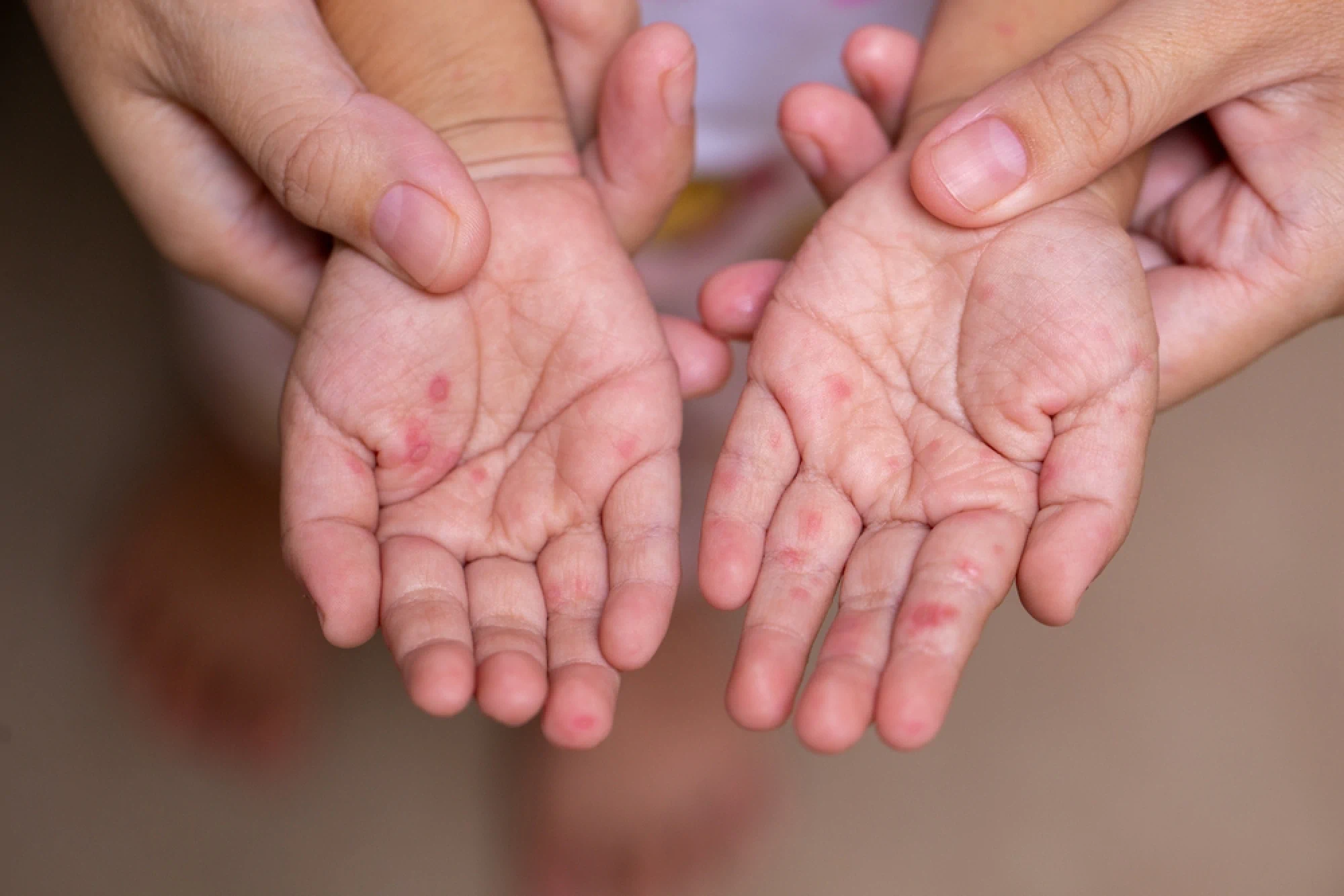
True to its name, HFMD causes small blister-like bumps on the palms of the hands, soles of the feet, and sometimes the buttocks or legs. These bumps can be uncomfortable but aren’t usually itchy.
Roseola
Roseola’s rash appears as small, flat, pink spots that start on the trunk and spread outward to the neck, arms, and face. It’s not usually painful or itchy either, which can make it tricky to distinguish from other viral rashes, an RSV rash, or even a skin infection without knowing the full symptom picture.
Difference 3: Mouth sores
HFMD
Mouth sores are one of the biggest giveaways for HFMD. Small, painful ulcers can develop on the tongue, gums, and inside of the cheeks, often making it uncomfortable for kids to eat or drink.
Roseola
Roseola typically doesn’t cause mouth sores at all. If your child has a fever followed by a rash but no mouth pain, that points away from HFMD.
Difference 4: Age
HFMD
HFMD most commonly affects children under 5, though older kids and even adults can catch it, especially in households or classrooms with a lot of close contact.
Roseola
Roseola tends to show up earlier, usually between 6 months and 2 years old. Most children have been exposed to HHV-6 by kindergarten age, which is why roseola is rare in older kids.
Difference 5: Season
HFMD
HFMD cases tend to climb during the summer and fall, and outbreaks often spread through daycares and schools where kids share close quarters. Watching for signs of sickness in schools can help you catch it early before it spreads further.
Roseola
Roseola doesn’t follow a strong seasonal pattern and can appear at any time of year. Because the fever alone can look like a lot of other common viral illnesses, it’s often the rash that finally confirms the diagnosis.
When to take your child to the ER for roseola or HFMD
Most cases of roseola and HFMD can be managed at home with rest, fluids, and fever control. But certain symptoms, like a fever that won’t come down, signs of dehydration, or difficulty breathing, mean it’s time to seek pediatric emergency care right away.
Seek emergency care if your child has:
- A fever above 104°F, or any fever in an infant under 3 months old
- Signs of dehydration, such as no wet diapers in 8 hours, no tears when crying, or a sunken soft spot
- Difficulty breathing or swallowing
- Extreme lethargy, or trouble waking up
- A stiff neck, severe headache, or repeated vomiting
- Mouth sores so painful your child refuses all food and liquids
- A rash that turns purple or looks like bruising, rather than flat pink spots or fluid-filled bumps
Roseola fevers can spike quickly and climb high, which is unsettling to witness even when it’s not dangerous. Watching how your child responds, not just the number on the thermometer, is often a more reliable guide. A child who’s fussy but drinking fluids and staying alert is very different from one who’s limp, unresponsive, or struggling to breathe.
When in doubt, it’s always safer to have a child seen than to wait it out at home.
FAQs
What could be mistaken for roseola?
Roseola is often mistaken for other viral rashes, drug reactions, or measles because the pattern of fever followed by rash is common to several childhood illnesses. Fifth disease and certain allergic reactions can also produce a similar flat, pink rash on the trunk. The fever-then-rash sequence, along with your child’s age, is usually the best clue for narrowing it down.
Can roseola be mistaken for hand foot and mouth?
Yes, especially in the early stages when both conditions start with a fever and general fussiness before any rash appears. Once the rash shows up, though, the two are easier to tell apart since HFMD concentrates on the hands, feet, and mouth while roseola spreads across the trunk and face.
Can HFMD go away in 3 days?
HFMD symptoms typically last 7 to 10 days, though the fever usually breaks within the first 2 to 3 days. Mouth sores and the rash on the hands and feet can linger a bit longer, even after your child starts feeling better and acting more like themselves.
How long is a child contagious with HFMD or roseola?
Children with HFMD are most contagious during the first week of illness, though the virus can still be present in stool for weeks afterward. Roseola is contagious even before the fever starts, which is one reason it spreads so easily through daycares before parents realize what’s going on.
Can adults get HFMD or roseola from their child?
Adults can catch HFMD, though it’s less common and symptoms tend to be milder than in kids. Roseola is rare in adults since most people are exposed as young children and develop lasting immunity to the virus.
Still worried about that rash? Our freestanding ER is open 24/7.
Telling the difference between hand foot and mouth disease vs roseola often comes down to watching the details: when the rash appears, where it shows up, and whether your child has mouth sores. But you don’t have to be the expert. If a fever won’t budge, a rash looks unusual, or your gut is telling you something’s off, our emergency-trained physicians are ready to help any time, day or night.
Complete Care has freestanding ER locations in Austin, Corpus Christi, Dallas/Fort Worth, East Texas, Lubbock, San Antonio, and Colorado Springs, with no appointment needed and no long waits. When in doubt, skip the guesswork and come see us.
More Helpful Articles by Complete Care:
- When to Go to the ER for Blurry Vision After Hitting Your Head
- Can Bronchitis Turn into Pneumonia?
- Left Side Abdominal Pain: Common Causes & When to Go to the ER
- When to Go to the ER for Shortness of Breath
- 8 Reasons for a CT Scan

Reviewed By:
Jeffrey Peebles, M.D.
Complete Care's health articles are based on evidence-based medical information and reviewed by Dr. Jeffrey Peebles, Medical Director of Complete Care Southlake, to ensure accuracy and alignment with current medical standards.

Get Complete Care
Open 24/7. No Appointment Needed.